The Real ROI of Sponsorship Is Not Reach

Uncategorized

The Real ROI of Sponsorship Is Not Reach

The Real ROI of Sponsorship Is Not Reach

Brands have been measuring the wrong thing for decades. Here is what actually moves the needle in modern sports sponsorship, and why the agencies still selling impressions are selling you short.

Every year, brands collectively spend over $100 billion on sports sponsorships globally. And every year, a significant portion of that investment is evaluated on a metric that was never designed to measure what sponsorship actually does.

Reach. Impressions. Media equivalency value.

These numbers look impressive in a post-campaign report. They rarely tell you whether anyone cared.

The sports sponsorship industry has a measurement problem. Not a spend problem. Not a creativity problem. A measurement problem, and it starts with the stubborn persistence of reach as the default proof of ROI. It is time to retire it.

The obsession with reach made sense in a previous era. When broadcast television dominated sports consumption, audience size was a legitimate proxy for exposure value. The more eyeballs on a match, the more times your logo on the perimeter board was theoretically seen. Simple arithmetic. Easy to sell to a CFO.

Media equivalency value, the practice of estimating what the sponsorship airtime would cost if purchased as advertising, extended the logic further. It gave sponsorship managers a number that sat comfortably inside existing marketing budget frameworks.

The problem is that the era that created these metrics no longer exists.

Attention is now the scarcest commodity in sport. The average fan does not watch a match, they experience it across five platforms simultaneously, filtering out commercial noise at a rate that would have been unimaginable twenty years ago.

A logo seen is not a brand felt. And a brand that is not felt does not convert.

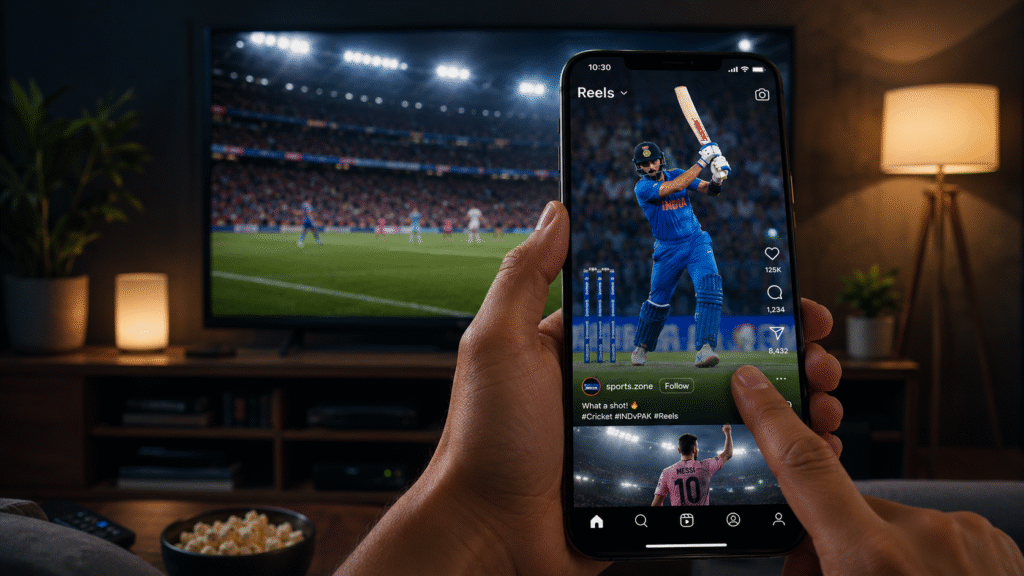
The data on this is no longer ambiguous. According to GWI’s Global Sports Trends research, 72% of sports fans use social media to follow sport, often simultaneously with broadcast viewing. Fans are scrolling, clipping, reacting, and sharing in real time. They are not passively absorbing brand messages in the way reach metrics assume.

PwC’s research on younger fan engagement confirms the structural shift: Gen Z fans, the generation that will define the next two decades of sports fandom, prefer short-form content and streaming platforms over scheduled broadcasts. They discover sports, teams, and brands through algorithms, not through stadium signage.

“Reach tells you how many people were in the room. Engagement tells you whether anyone was listening. Sponsorship ROI lives entirely in the second number.”

The implication for modern sponsorship strategy is significant. Passive visibility, the jersey logo, the LED board, the naming rights, is table stakes. It creates the permission to exist in a sporting context. It does not create the relationship that generates commercial return. What generates return is activation. Specifically: the strategic, creative use of sponsorship rights to build genuine, participatory experiences that fans choose to engage with.

If reach is the wrong primary metric, what replaces it? The most commercially effective sponsors in sport are building their measurement frameworks around a hierarchy of value, from awareness at the base to community and conversion at the top.

TYPEMETRICWHAT IT MEASURES
Old MetricReach / ImpressionsPassive logo exposure
Old MetricMedia Equivalency ValueEstimated ad-buy cost
Modern MetricEngagement RateActive fan interaction per asset
Modern MetricParticipation RateFan involvement in activation
Modern MetricBrand Sentiment LiftPre/post-campaign affinity shift
Modern MetricCommunity GrowthOwned audience built through sport
Modern MetricConversion AttributionDirect commercial outcomes traced to sponsorship

This is not about abandoning awareness metrics entirely. It is about subordinating them to the metrics that actually predict commercial outcomes: engagement, participation, sentiment, and conversion.

THE INTERNAL LINK OPPORTUNITY For brands already investing in sports sponsorship and asking why the returns are not materialising, the answer is almost always the same: the rights were purchased, but the activation strategy was underfunded or absent entirely. Explore our guide to sponsorship activation strategy for a practical framework.

The brands generating the strongest returns from sports sponsorship share a set of structural behaviors that distinguish them from the market. They are not all spending more. In several cases, they are spending less on rights and significantly more on what happens after the deal is signed.

  • Emotional connection:  Fans who feel an emotional link between a brand and their sport spend more, advocate louder, and retain longer. Emotional ROI is not soft, it is the upstream driver of every hard commercial metric that follows.
  • Participation-driven activation:  Brands that give fans something to do, not just something to see, generate exponentially higher engagement. Experiential fan zones, co-creation campaigns, community events: these are the assets that move brand health scores.
  • Athlete and creator authenticity:  The most powerful content in modern sports marketing is not produced by agencies. It is created by athletes and fan-creators who have earned trust that no media buy can replicate. Brands that build this into their sponsorship activation strategy gain reach that feels earned, not purchased.
  • Community ownership:  The brands winning long-term in sport are building owned communities around their sporting associations, email lists, Discord servers, social followings. These are assets that outlive any individual sponsorship term.

Red Bull did not sponsor extreme sports. It created them, owned them, and used them as the world’s most effective brand storytelling platform. The ROI of Red Bull’s sporting investments is not measured in logo impressions, it is measured in the brand’s complete ownership of a cultural territory. Every Red Bull athlete, event, and piece of content serves the brand narrative directly. The result is a sponsorship model with a near-zero media equivalency value and an incalculable brand value.

The lesson: when a brand stops buying space in sport and starts creating the sport itself, the commercial ceiling disappears.

Formula 1’s commercial transformation over the last decade is the most studied audience growth story in sports marketing. The Netflix Drive to Survive series did not merely document the sport, it restructured the emotional architecture of fan engagement. Suddenly, fans cared about team principals. About constructors’ battles. About the human drama behind the fastest sport on earth.

Sponsoring brands inside that ecosystem did not just gain reach. They gained access to a dramatically more emotionally engaged, younger, and globally diverse audience, one whose sponsorship receptiveness was fundamentally higher than the pre-Drive to Survive baseline.

The lesson: fan engagement is an upstream multiplier. Brands that enter a sport at peak engagement get a different quality of attention, and a different quality of return.

Nike’s sports sponsorship strategy has always been built around participation, not visibility. The Nike Run Club is not a product. It is a community of millions of people whose relationship with running, and with Nike, was forged through shared experience, not advertising exposure.

That community is the ROI. It is owned, not rented. It generates data, advocacy, and purchase behavior that no media buy can replicate. And it was built, deliberately, by treating sport as a platform for human connection rather than a vehicle for brand placement.

“The brands that win in sport are not the ones with the biggest logos. They are the ones who understand that the logo is just the door, and that everything valuable happens on the other side of it.”

The shift from reach-based to engagement-based sponsorship ROI is not a future consideration. It is a present commercial reality. Brands still optimising for media equivalency value are not just using the wrong metric, they are making structurally inferior investment decisions based on it.

  • Audit your metrics first:  Before your next rights renewal, establish what you are actually measuring, and whether those metrics have any predictive relationship with commercial outcomes. If the answer is primarily reach and MEV, the measurement framework needs rebuilding before the strategy can improve.
  • Budget for activation at the point of signing:  The brands generating the strongest sponsorship ROI consistently allocate at minimum a 1:1 ratio of activation spend to rights spend. Activation is not a support budget. It is the investment that makes the rights purchase valuable.
  • Build for participation, not observation:  Every activation strategy should ask: what do we want the fan to do? Not: what do we want the fan to see. Participation creates memory, advocacy, and commercial behaviour. Observation rarely does.
  • Measure what you can control:  Engagement rate, sentiment shift, community growth, conversion uplift, these are metrics your activation strategy directly influences. Reach is a function of the property you have bought. ROI is a function of what you build on top of it.

The real ROI of sponsorship has never been reach. It has always been relationship. The brands that understood this earliest, Red Bull, Nike, the title sponsors of the Drive to Survive era, have built sporting associations that generate compounding commercial returns year after year.

The brands still optimizing for impressions are paying premium prices for assets they are dramatically underusing.

Reach rents you a moment. Engagement builds a relationship. Community creates a business asset.

The measurement framework of the next decade of sports marketing will be built around fan engagement, participation, sentiment, and conversion. The brands that build for those outcomes now, with the right activation strategy, the right metrics, and the right investment balance, will not just generate stronger sponsorship ROI.

They will own the commercial territory that everyone else is only passing through.

READY TO RETHINK YOUR SPONSORSHIP ROI? At Arka Alliance, we help brands move beyond reach metrics and build sponsorship strategies that generate measurable commercial outcomes. If your current partnerships are not delivering the ROI they should, the problem is almost never the deal. It is what you do with it.

Share This :

Leave a Reply

Your email address will not be published. Required fields are marked *

Category

Empowering Brands to Leverage 
Sponsorships

Copyright @ 2025. All Rights Reserved | Created by The Kika