Reels, Shorts, and TikToks Have Changed Sports Fans Forever

Uncategorized

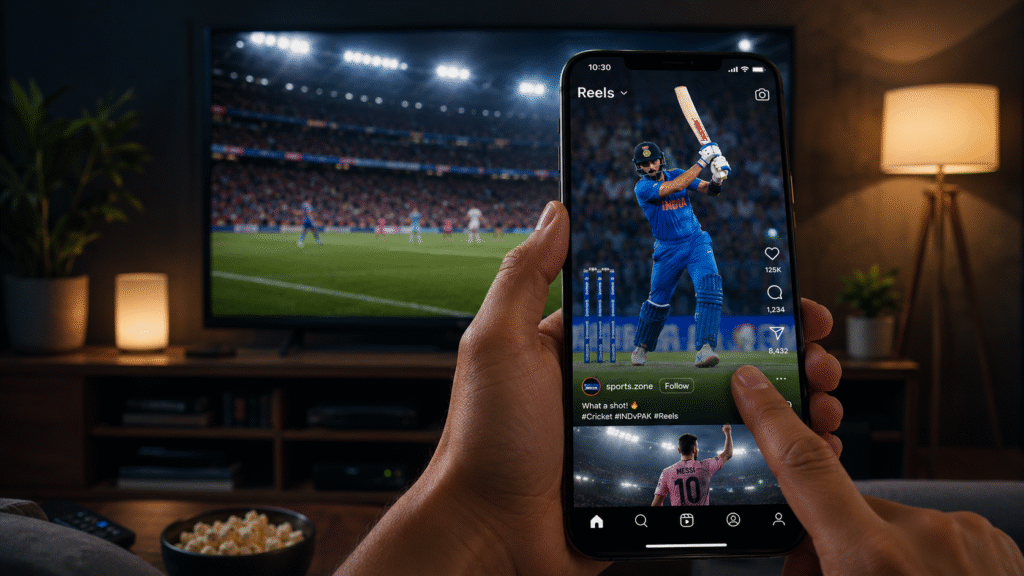
Reels as 2nd screen for sports

Sports are no longer consumed linearly. They are consumed algorithmically. Here is what that means for fandom, brands, and the future of sports marketing.

Somewhere between the final whistle and the next morning’s scroll, the way people experience sport fundamentally changed.

It did not happen overnight. But it happened completely.

Sports are no longer a live event first. They are a content ecosystem, one that runs 24 hours a day, seven days a week, on every screen, curated by an algorithm that does not care about kick-off times.

For most of the twentieth century, sports fandom was a linear experience. You watched the match. You read the back pages the next morning. And you discussed it at work. That was the loop.

That loop has been replaced by something far more fluid, and far more powerful. The average sports fan now encounters sport dozens of times per day: a goal clip on Instagram, a transfer rumour on X, a reaction video on YouTube, a meme on TikTok. They may never watch the full match. They experience the match anyway.

This is not casual fandom. This is feed-first fandom, and it is now the dominant mode of sports consumption for anyone under 35.

Let that land for a moment. Post-match content from a single sporting event generated more than twenty times the viewership of the live broadcast. The fans were not absent. They were watching, just not live, and not on the platform the rights holder controlled.

The audience did not shrink. It migrated.

Sports Influencers are the trend now

The NBA understood this before almost anyone else in professional sport. Its highlight culture, built deliberately, shared aggressively, accessible freely, turned individual moments into global cultural currency. A LeBron dunk does not belong to the arena it happened in. It belongs to the internet.

Formula 1 learned the same lesson through Netflix. Drive to Survive did not just document the sport, it restructured the emotional architecture of fandom entirely. Suddenly, casual viewers had favourite team principals. They cared about grid penalties. They followed drivers on Instagram. The clip brought them in; the story kept them.

Short-form content did something the sports industry did not fully anticipate: it made athletes into standalone media brands. Cristiano Ronaldo has more Instagram followers than the entire Premier League’s combined official pages. His content, training clips, lifestyle posts, reaction videos, generates engagement that no club’s communications team can match.

Gen Z’s fandom reflects this directly. According to the WSC Sports Generational Fan Study, Gen Z fans follow players first, teams second. The athlete is the team. The personality is the product. And short-form content is the distribution engine that made it so.

This has massive implications for sponsorship activation strategy. A brand partnership with the right athlete generates authenticity and reach that no stadium naming right can replicate.

Most followed Sportspersons on Instagram

Here is something the traditional sports media model never had to contend with: a teenager in Mumbai can become a passionate Formula 1 fan having never intentionally sought it out. A single Max Verstappen onboard clip, served by the TikTok algorithm, starts the journey.

This is sports discovery by feed. It is happening at scale, globally, every day. GWI data shows that 62% of sports fans discovered a new team, player, or sport through short-form video. The algorithm has become the most powerful talent scout, audience builder, and commercial pipeline in modern sport.

The question is no longer “how do we reach fans?” It is “are we being found?”

Football edit pages on TikTok. YouTube channels breaking down NBA film. F1 fan accounts with millions of followers. Meme pages that shape the cultural narrative around a transfer window more powerfully than any official club statement.

Creator-led sports content is not supplementary to official media. It is, for Gen Z, the primary experience of sport. These creators have earned the trust, tone, and cultural fluency that institutional sports communication rarely achieves.

Google ThinkSports data reinforces the commercial case: brands that leverage YouTube creators in sports campaigns generate 2.3x higher ROAS than those relying on traditional broadcast-adjacent placements. The creator is not just a content vehicle. The creator is a commercial asset.

This is the central challenge for sports marketing in 2026: fans have already moved. The consumption behaviour, the discovery patterns, the fandom architecture, it has all fundamentally restructured around short-form, social, creator-driven content.

And yet, a significant portion of sports marketing budgets remain anchored to live broadcast partnerships, perimeter boards, and media equivalency metrics that measure a world that no longer exists in the same form.

Share This :

Leave a Reply

Your email address will not be published. Required fields are marked *

Category

Empowering Brands to Leverage 
Sponsorships

Copyright @ 2025. All Rights Reserved | Created by The Kika