The Multi-Screen IPL: How Fans Watch Cricket in 2026
IPL fandom has moved beyond the broadcast. Here is what modern cricket consumption actually looks like, and what it means for every brand investing in Indian sport.
There is a moment every IPL evening that tells you everything about modern cricket fandom.
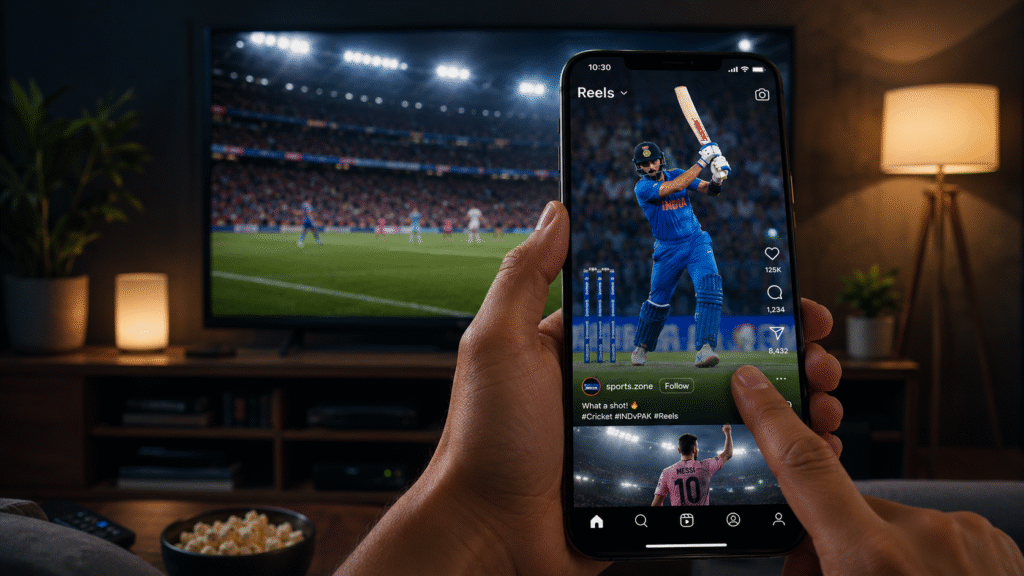
The ball is bowled. A wicket falls. And before the umpire’s finger has fully risen, the clip is already on Instagram.
The modern IPL fan is no longer just watching the match. They are living inside the conversation around it.
That shift, from passive viewing to active participation, is the defining change in how Indian cricket is consumed in 2026. And for brands, broadcasters, and rights holders still treating the IPL as primarily a television event, it represents both a risk and a significant missed opportunity.
THE NEW VIEWING REALITY
From One Screen to Many: How IPL Consumption Has Evolved
Not long ago, IPL viewing was a household ritual. One television. One broadcast. The family gathered around the same screen for the same three hours. It was linear, communal, and predictable.
That model has not disappeared. It has fragmented, into something simultaneously more complex and more engaged.
Today’s IPL fan watches the match on JioCinema or a television broadcast while simultaneously scrolling X for reactions, checking their Dream11 fantasy team, watching a creator’s live commentary on YouTube, and sending memes in a WhatsApp group. None of these activities replace the match. They extend it, into a continuous, multi-layered experience that runs long before the toss and long after the final ball.

| 90% OF SPORTS FANS ACTIVE ON 2–3 SCREENS DURING LIVE MATCHES | 2.3× HIGHER ROAS WHEN BRANDS LEVERAGE CREATOR-LED CONTENT | 24/7 IPL CONTENT CYCLE, THE MATCH IS ONLY THE BEGINNING |
THE SECOND-SCREEN ECONOMY
Second-Screen Behavior Has Become First-Screen Reality
The industry term “second screen” already feels dated. For a significant portion of the IPL’s core audience, particularly the under-35 demographic, the social feed is not secondary to the broadcast. It is co-primary.
Research consistently shows that 90% of sports fans use two to three screens simultaneously during live events. For IPL, that number is likely higher. India has the world’s largest mobile internet user base, and the IPL audience skews younger and more digitally native than almost any other major sports property globally.
The implications for attention allocation are significant. A brand’s sponsored moment in the broadcast is competing not just with rival sponsors but with the fan’s own social feed, which is, by design, more engaging, more personalised, and more immediately rewarding than any thirty-second spot.
| “IPL is no longer just a live sports product. It is a continuous content ecosystem, one that runs on every platform, at every hour, driven as much by fans as by broadcasters.” |
THE CREATOR ECONOMY
Why Fan Pages and YouTube Creators Are the New IPL Media
Some of the most-viewed IPL content in 2025 and 2026 was not produced by BCCI, by franchises, or by official broadcast partners. It was made by fan accounts, YouTube analysts, meme pages, and independent creators whose audiences trust them precisely because they are not institutional.
The fastest six of the season becomes a reel within minutes. Post-match analysis from a creator with two million subscribers generates more engagement than the official post-match press conference. A well-timed meme after a surprise result spreads further than any franchise’s planned social content could.
Creator-driven sports content generates 2.3 times higher return on ad spend compared to traditional broadcast-adjacent placements. This is not a marginal difference. It reflects a fundamental shift in where trusted, resonant sports attention lives in 2026.

| WHAT SMART IPL BRANDS ARE DOING DIFFERENTLY Partnering with creators whose audiences align with their target demographic, not just with the broadcast property. Investing in post-match and highlight content placement, where engagement data shows viewership significantly outpacing live-only numbers. Building always-on social strategies around IPL, not just match-day activation plans. Treating IPL fandom as a 60-day content ecosystem, not a 7-week broadcast schedule. |
FRANCHISES AS CONTENT STUDIOS
IPL Teams Are No Longer Just Cricket Clubs. They Are Media Brands
The smartest IPL franchises have understood something that took traditional sports organisations decades to recognise: the match is the content anchor, but it is not the only content.
Mumbai Indians, Chennai Super Kings, and Royal Challengers Bengaluru now operate with content strategies that extend far beyond match-day communications. Training ground access. Player personality content. Regional fan engagement. Social-native formats built specifically for reels and shorts rather than repurposed broadcast footage.
The franchise that wins the content calendar wins a different kind of loyalty, one that persists between seasons, not just between overs.
| THE ARKA ALLIANCE PERSPECTIVE The Attention Has Moved. The Strategy Must Follow. The IPL’s broadcast numbers remain extraordinary. Hundreds of millions of viewers. Record streaming figures on JioCinema. The live match is still the engine of the entire ecosystem. But the engine is no longer the only thing worth investing in. Post-match content, creator partnerships, second-screen activations, and always-on social strategies are where a significant and growing share of genuine fan attention now lives. Brands that treat IPL as a television event with a social media afterthought are misreading the room. The fans have already moved. The attention is fragmented, digital, and continuous. The marketing strategy had better be too. |